State-Owned Enterprises and Economic Development in Asia

Box 1.4: The Role of the Public Sector – A Case Study of the Republic of Korea
The Republic of Korea is a classic case demonstrating the usefulness and merits of government flexibility in adopting a different role at each phase of development. In the early stages of development, governments typically select the sectors to invest in. However, as economies develop and modes of production become more complex, the role of the private sector increases.
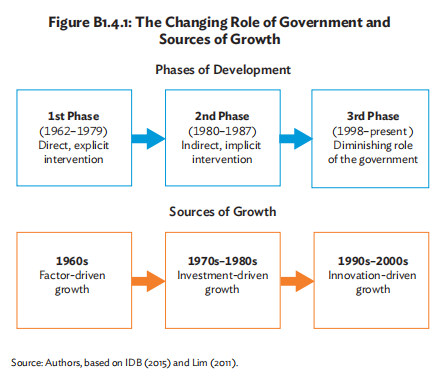
Economic development in the Republic of Korea can be divided into three distinct phases. During the first phase (1962–1979), the government played a major role in leading development and mobilizing resources to promote economic development. In the second phase (1980–1989), government control became indirect and implicit, rather than explicit. At the same time, the private sector rapidly grew, increasing its investments especially in the finance sector. In the third phase (1990 to present), the government became a facilitator while the private sector took the lead. After the Asian financial crisis in 1997, it became clear that government failure brought more danger than market failure, thereby diminishing the government’s role in the economy (Figure B1.4.1).
For example, in the early stages of development, the government was active in selecting sectors and supported economic growth mainly by increasing the inputs of labor and capital. Despite extensive state intervention in economic affairs, the government managed to contain corruption and rent-seeking. More importantly, as market capacity and the state and non-state actors changed, their respective roles began to shift as well. The 1997 economic crisis provided an opportunity to introduce market-based discipline, clean up massive nonperforming loans, improve corporate governance, promote competition, and strengthen the social safety net.
As the private sector grew stronger, the focus of government support shifted to “indicative” targeted industries, and assistance was confined to research and development efforts and to promote private sector development. Additionally, the government invested massively in information technology and infrastructure and succeeded in improving science and technology capacity and in facilitating productivity-led growth.
The Republic of Korea’s economy evolved throughout the development process— relying initially on factor-driven growth before transitioning to productivity led growth in which the private sector played a more dominant role. More significantly, government policies instilled a sense of competition and dynamism, enabling the public sector to compete and improve its delivery of public services. The government provided a level playing field to promote the private sector, addressed the problems of innovation and coordination externalities through public–private partnership, and helped promote productivity-led growth.
Source: Authors, based on Lim (2011) and IDB (2015).
Empirical analysis[x] based on the Orbis database for the selected countries in our study also corroborates the probability of significant gains when factors of production are allocated more appropriately. The results reveal that with improved corporate governance and efficient utilization of resources, SOEs’ output in Kazakhstan and Indonesia can be expanded by at least 17% and 32%, respectively. Similarly, in the PRC, at least 9% additional output can be produced with a similar level of input. On the other hand, both Sri Lanka and Viet Nam, which are far away from the efficient frontier, can substantially enhance SOEs’ output with proper allocation of resources (Figure 1.13).

The foregoing discussion suggests that with proper allocation of resources, the output of SOEs and public service delivery can be improved substantially in countries within the efficient frontier. DMC governments should make best use of available resources to improve SOE performance, thus helping enhance the quality of public services. Productivity-induced growth is not only important in coping with the challenges of middle-income countries, it is also crucial in bridging the gap between nations.
Governments will need to employ state-of-the-art technology and find ways to make enterprises more efficient and innovative. Furthermore, a level playing field and a competition-oriented environment will encourage private sector entrepreneurs and new firms to come forward and help achieve innovation led growth.
1.12 Pathways to SOE Reform
Countries have adopted different approaches to SOE reform, as dictated by political preferences, general economic conditions, institutional capacities, interactions with international development agencies, and several other factors. There is no “one-size-fits-all” approach to SOE reform. As noted, some countries have opted for a “big bang” approach to privatization during their transition from a planned to market-oriented economy. In other countries, external factors have been significant, such as the PRC’s reforms as a condition of World Trade Organization entry, and Indonesia’s reforms as part of its 1997– 1998 IMF crisis rescue package.
What follows here are illustrations of various options drawn from country experiences and organized around the general objective of improved enterprise efficiency, consistent with the national development objectives of inclusive and sustainable growth.
- Hard budget constraint. This option is an essential prerequisite for SOE reform—SOEs must manage their operations within defined financial parameters. Budget constraints impose a discipline on the management of SOEs. They also protect the country’s fiscal position. The absence of hard budget constraint was the single most important explanation for the occurrence of hyperinflation in transition economies (such as Viet Nam), when SOEs, and state-owned banks in particular, accumulated very large deficits which in turn central banks monetized. An explicit provision for contingent liabilities is also essential, within and beyond the SOE sector.
- Transparency. SOE operations are frequently not transparent. The direct subsidies they receive are often not reported in the government’s budget, and the indirect subsidies are not costed. Politically, the absence of public accountability makes reform very difficult.
- Explicit costing for public service obligations. SOEs typically carry many public service obligations (PSOs), which need to be explicitly costed and accounted for in any SOE performance evaluation. In most cases, such estimations are relatively straightforward. If a state-owned electricity utility is required to service customers (or a segment of them) at an uneconomic price, the difference between the market price and regulated price is the cost of the PSO. Similarly, if an SOE transport provider is required to provide below cost services (for example, as an alternative to a congestion tax), this PSO can likewise be estimated.[xi]
- Public asset management. Professional and better management of public assets can increase transparency and accountability and lead to higher financial and social gains. Experience across countries suggest that professional management of public assets allows governments to raise expenditures during times of crisis and help maintain macroeconomic stability. Recent episodes of financial crises have further underscored the importance of effective management of public assets and SOEs. Hence, efficient management of public assets and SOEs not only help in improving the fiscal position but also in raising the quality of public service delivery.
- The importance of competition. The regulation of SOEs that operate in competitive markets is relatively straightforward. The performance of SOEs can be benchmarked against private sector competitors, factoring in any subsidies and PSOs. As a corollary, it is important to remove any regulatory constraints on competition (e.g., barriers to private sector entrants). For tradable activities, this also includes ensuring that import competition operates without hindrance. This is an important area of work for the region’s nascent competition commissions.
- SOEs and “natural monopolies.” SOEs are frequently found in sectors that may be described as having “natural monopoly” characteristics, that is, with a declining long-term average cost over all feasible levels of output. In practice, the definition of a natural monopoly is not straightforward. For example, electricity generation and transmission were once considered to be such a case, and therefore best suited to a sole supplier. However, new solar generation technologies are radically changing the sector’s economics. The same applies to mobile telephony services. For other cases of natural monopolies, mainly in the utilities sector, regulation is a key issue whether or not the sector is state-owned. The appropriate policy regime is one in which an independent, arms-length regulator monitors and, if necessary, determines pricing and service quality. Such a body of course assumes high-level governance capabilities. To improve the public service delivery, governments should introduce professional management and enhance the corporate governance of SOEs.
- Sequencing matters—getting privatization “right.” As argued above, privatization is one possible SOE reform option. However, it should be regarded as the final step in the process, after all the preliminary reforms have been completed. These include establishing an appropriate regulatory/competitive framework, accurate and transparent financial reporting, and explicit costing of any remaining PSOs.
Privatization remains a politically controversial issue in several countries. In these cases, opening the SOE sector to private sector competition is a more palatable option, as in the case of the 1997 reform of Manila Water. If privatization is to be pursued, it is also crucial to handle the process of divestment in an open, competitive, and nonpolitical environment that maximizes the return to the state. There are well-documented cases, mainly in the transition economies in which SOEs are disposed of at highly concessional prices to the politically well-connected (termed “insider privatization” in the PRC). In such cases, it is arguably preferable not to proceed with privatization.
1.13 Summing Up
SOEs are major commercial entities, invariably larger than commonly realized, and typically more important in developing Asia and Pacific economies than in the advanced economies. They are particularly important in sectors that have weak competitive pressures, and in sectors such as mining and natural resources that are commonly bedeviled by governance problems. Their size and their generally indifferent performance highlight the importance of reform.
There is no template or single path to reform, as approaches will differ depending on institutions, history, and political preferences. However, there are common elements of a reform agenda, including the importance of hard budget constraint, financial accounting transparency, competitive market structures, and a regulatory framework that protects the public interest. It may be the case that privatization is the preferred approach, but this will be effective only if the necessary prerequisites are in place.
______________________
[i] State capitalism is an economic system in which the state plays a dominant role in different sectors through government ownership and control.
[ii] Throughout this study, the term “SOE” is defined in different ways across countries. In Malaysia and Singapore, for example, the term “government-linked corporation” (GLC) is widely used. In Viet Nam, the term
“equitization” refers to SOEs that have been corporatized.
[iii] The Prebisch–Singer hypothesis argues that the price of primary commodities declines relative to the price
of manufactured goods over the long term, which causes the terms of trade of primary-product-based
economies to deteriorate.
[iv] Fortune. Global 500. https://fortune.com/global500/2019/search/.
[v] The Orbis database provides a comprehensive, wide-ranging, and consistent data set for state-owned and
private companies, thus making comparison across countries reliable
[vi] Orbis covers all the listed companies. However, not all listed companies share information about their financial statistics. For consistency, analysis is limited to those SOEs for which financial data are made available to the Orbis database. The number of SOEs with financial data is much smaller than the number of listed companies.
[vii] In the world of finance, the term equity generally refers to the value of an ownership interest in a business, such as shares of stock held. On a company’s balance sheet, equity is defined as retained earnings, plus the sum of inventory and other assets, and minus liabilities
[viii] The public sector balance sheet consists of the assets and liabilities of general government and public
corporations, including the central bank. Hence, it brings together all of the accumulated government
controlled assets and liabilities (IMF 2018)
[ix] It is worthwhile to note that after 18 years of MWSS privatization, water supply has significantly improved.
Nevertheless, the current arrangement is far from perfect, and Metro Manila still experiences water shortages.
On top of that, the government has recorded about 38 million cases of diarrhea annually due mainly to poor
sanitation and hygiene. Tap water is still not safe to drink. The government is once again considering to revisit
the concession agreement and introduce further reforms to improve the quality and quantity of water.
[x] These results are based on the data envelopment analysis which captures the operational efficiency of SOEs
in the selected countries. Appendix A1.2 provides more details.
[xi] It is important of course to benchmark the full cost of the service against some independently agreed figure,
not the one a possibly inefficient SOE provides. In the case of incomplete markets (for example, information
asymmetries), these prices may not be readily available. International benchmarks can be an option.